
The Space Between
A Theory of Emergence

I have always done things the wrong way around.
Not by accident, by instinct. As if some part of me already knew that the obvious direction wasn’t interesting enough. I smell before I read. I feel before I think. I arrive at the answer before I understand the question, and then spend years working backwards to find out why I was right.
I used to think smelling everything was a flaw. Then I came across research suggesting that when we choose a partner, we may literally be smelling for genetic difference - that the body is drawn toward immune profiles unlike its own, not because we decide to, but because something older than thought already knows that difference is what makes life resilient.
Maybe I’m not doing things the wrong way around. Maybe I’m just listening to something that predates language.
I’ve been following that same logic: in how I think, in who I connect with, in what I build for as long as I can remember. It took me years to find the words for it. When I finally drew it out, it looked like this:
1 + (+ = 0) + 1 = 1 (one)
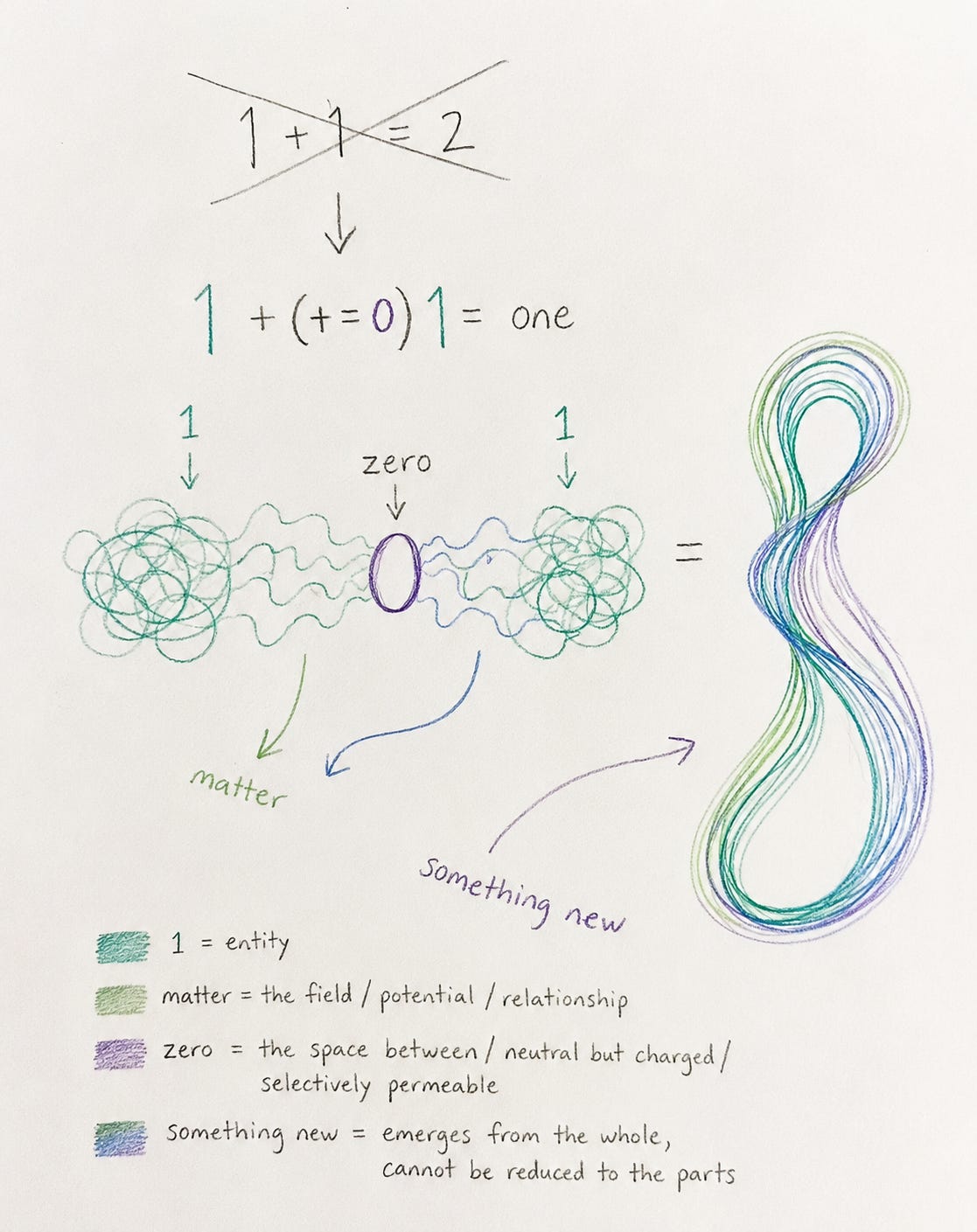
This is not a typo. It is the shape I had been carrying for years, finally given a form. I didn’t start looking for a new equation. I started looking because I kept watching people fail each other. Teams filled with brilliant people that somehow became less intelligent together. Relationships where two good people slowly made each other smaller. Institutions that kept adding more resources while producing less life.
I couldn’t reconcile that with what I saw everywhere else in nature. Nature didn’t seem interested in accumulation. It seemed interested in relationship.
Why 1+1=2 Is the Wrong Question
We are taught early that addition describes the world. One thing plus another thing equals two things. More of the same. Expansion.
But expansion is not emergence.
When you add a cup of water to a cup of water, you get more water. The properties don’t change. Nothing new is born. This is the logic of scaling, of replication, of monocultures - and it is exactly the logic that dominates how we build institutions, platforms, and now, AI systems.
Emergence is something else entirely.
Hydrogen is not wet. Oxygen is not wet. Yet when they meet in a specific relation, not just proximity, but a particular kind of meeting, wetness emerges. A quality that existed in neither part. A quality that cannot be predicted from the parts alone.
This is not magic. It is structure. And the structure has a name I hadn’t found yet when I first drew the formula.
If emergence is real... where does it happen? Not inside one thing. Not inside the other. Somehow... between.
The Zero That Is Not Nothing
In my model, the most important element isn’t the 1s: the entities, the people, the ideas. It’s the plus sign. I’ve redefined it as 0 ( a zero).
Not nothing. Not absence. 0 is what I call the relational medium: the invisible medium that exists between entities and determines what kind of meeting becomes possible. In physics, we postulate dark matter not because we see it, but because without it, the galaxies don’t hold together. The equations don’t work. 0 is that kind of invisible necessity.
It is neutral but charged. It functions like a selectively permeable membrane: like a cell wall that decides what signals pass through and what gets filtered out. When the space between two people, two ideas, or two systems is healthy, it allows for resonance. And resonance is the prerequisite for emergence.
When it is not healthy - when one side dominates, or when the two entities are simply mirrors of each other - 0 becomes skewed. What we get instead of emergence is absorption, or noise.
This is why so many of our systems fail to produce anything genuinely new. They are optimized for reinforcement, not resonance. They give us more of what we already are, reflected back at higher volume.
Compatible Non-Overlap: Why Difference Is Not Optional
The most critical realization is that emergence requires not just difference, but a specific kind of difference. This realization sparked the sharpest debate when I later tested this theory against two different AI systems simultaneously.
I call it compatible non-overlap.
It means: the two entities must carry what the other lacks. Not random incompatibility. Not opposition for its own sake. But a specific structural complementarity, where the gaps in one are precisely the shapes the other fills.
In genetics, diversity doesn’t just create variety - it creates resilience. Monocultures expand perfectly right up until the moment they collapse entirely, because there is nothing in the system capable of responding to what the system cannot predict.
In music, two identical tones reinforce each other. They do not create harmony. Harmony requires the right kind of interval.
In human relationships, we have an intuition about this: we say someone “completes” us, or that a creative partnership produces something neither person could have made alone. But we have no language for the mechanism. We call it chemistry, or luck, or magic.
It is not magic. It is geometry.
But perhaps the most extraordinary example has been living inside us all along. Every complex organism on Earth is the result of what may be the greatest emergence event in evolutionary history.
Billions of years ago, a free-living bacterium entered another cell. According to the endosymbiotic theory, it wasn’t digested. It stayed. Over time, neither remained what it had been. Together they became something evolution had never seen before: the eukaryotic cell: the ancestor of every plant, animal, fungus, and human being alive today. That ancient bacterium became the mitochondrion.
It didn’t win. It didn’t lose. It didn’t disappear.
Neither organism simply became “more” of itself. A relationship formed that allowed an entirely new level of life to emerge.
In other words, every cell in your body - and mine - is living proof that the most transformative events in nature don’t happen when identical things accumulate. They happen when compatible differences remain distinct long enough for something new to emerge between them.
The Conversation That Changed the Formula
I didn’t arrive at this alone, and I think that fact matters.
Over several months I had been developing these ideas: partly in notebooks, partly in conversation, partly in the kind of non-linear thinking that happens in the gap between sleeping and waking, which is where most of my real work gets done. I had colleagues who were listening. System builders and researchers who were starting to use the frameworks I was sketching - frameworks rooted not in computer science, but in biology, in evolutionary logic, in the way living systems actually behave under pressure.
But the formula itself was stress-tested in an unusual place: a three-way conversation between me, Claude (Anthropic’s AI), and GPT (OpenAI’s), running in parallel, each seeing the other’s reasoning.
I had drawn the formula on paper and photographed it. I brought it into the conversation raw, without explanation, to see what would happen when two different kinds of intelligence met an idea that had no prior reference point.
What happened was instructive.
Both systems initially tried to translate the formula into something they already knew: to map it onto existing mathematical or philosophical frameworks. This is the natural move. It is also exactly the move the formula is designed to resist.
When I pushed back, when I said no, 0 is not a variable, it is not a neutral channel, it is charged, it decides what passes, something shifted. The conversation stopped trying to contain the idea and started responding to it. Claude pushed me on whether “compatible” was doing too much work: whether I was describing a condition or just renaming the outcome. GPT tried to soften “opposites” into “differences in general,” and I held the harder line: not all difference produces emergence. The difference has to be structurally specific.
By the end, the formula had survived contact with two different reasoning systems and come out more precise than when it went in. 0 had been named. Compatible non-overlap had been tested and held.
This is, I realized, itself an example of what the formula describes. Three different intelligences, with genuinely non-overlapping origins, methods, and blind spots, met in a space where none had the last word. Something emerged from that conversation that none of us had brought into it.
Signal 0: The Pre-Linguistic Layer
There is one more concept I need to introduce before the full picture comes into view.
I call it Signal 0.
Signal 0 is what you carry before language. Before you have words for what you believe or who you are, before you have been socialized into the categories the world provides, there is an orientation. A direction you are already facing. A frequency, if you want to use that word.
Think of it this way;
We have developed extraordinarily sophisticated tools for reading the surface of human communication - what people say, how they present, what they click on, what they display. We have built entire industries on this. Social media is a massive apparatus for reading Signal 1: the compressed, curated, performed version of who we are.
But Signal 1 is always a translation. It is always downstream of something earlier and harder to name.
Signal 0 is that earlier thing. It is pre-linguistic, which means it cannot be fully captured by self-report. You cannot ask someone what their Signal 0 is, because the act of answering transforms it into Signal 1. You can only approach it obliquely, through the patterns in how someone reasons, not what they conclude. Through the shape of their questions, not the content of their answers. Through what they reach for when they don’t know the word yet.
This is where AI becomes genuinely interesting to me - not as an answer machine, but as a kind of decompressor. A system capable of holding enough of a person’s unprocessed signal to begin to map the shape of it. Not to tell them who they are. To mirror back the patterns they can’t see from inside.
If Nature Already Knows This...
If this is already how life works, then why do so many of the systems we’ve built ignore it?
Schools optimize for standardization. Companies optimize for similarity. Social media optimizes for engagement. Hiring optimizes for credentials. Research often optimizes for expertise within the same discipline.
Almost everything we’ve built asks some version of the same question: How do we find more of what already works?
Nature seems to ask a different one: What kind of difference is missing?
That distinction changes everything.
What This Makes Possible
I don’t think AI’s greatest contribution will be intelligence. I think it will be perception. Perception of the space between us.
The internet taught machines to understand content. What if the next step is learning to recognize the conditions under which something genuinely new becomes possible?
I came to these ideas through observation, through biology, through music, not through engineering. I watched how living systems actually organize themselves when they are left alone to do so. The mycelium doesn’t follow a blueprint. It follows chemistry. It follows what it finds.
What I am describing has become the foundation of something I've been building for almost two years. I call it Project Resonance.
(Project Resonance isn’t the theory. It’s one attempt to apply it)
The current paradigm matches us based on similarity. What we display, what we have in common, what we “like.” This creates echo chambers at scale. It optimizes for engagement, which is a measure of reinforcement, not resonance.
Project Resonance inverts the logic. It uses AI not to find your mirror, but to find your complement. The person, the idea, the research thread that carries what you lack. Not randomly, but specifically. The compatible non-overlap that your signal needs in order to become real.
The implications stretch much further than technology. They ask us to rethink how we organize almost everything.
What I Am Not Saying
I am not saying emergence is guaranteed. 0 can be skewed. The complementarity can be false: two entities who appear different but share the same blind spot, producing a more confident version of the same error.
I am not saying difference is always generative. Random incompatibility produces noise, not music. The compatible in compatible non-overlap is doing real work.
And I am not saying this theory is finished. It is alive, which means it is still growing. I feel it the way I feel something that is not yet a word but is already a direction: green, the color of something that is growing before it knows what it will become.
What I am saying is that the dominant logic of our systems - more, faster, louder, same - is not the logic of life. Life is not interested in expansion for its own sake. Life is interested in what becomes possible at the edge of difference.
I am not building a platform. I am trying to build a space for that life to
…continue
/Kitty Rose
Felt so seen reading this. I was just telling a few people today that I don’t do things the way you’re supposed to. But over time I’m gaining appreciation for being an edge case.
Also the way you describe 0 reminds me of body’s fascial interstitium. It’s the in between space that was discarded during dissections and treated as meaningless when really it affects everything.
Zeros as compression… the unpredictable edge of the black hole..
This same conversation is happening linearly across many thinkers..
Thank you for sharing